Friday, February 3, 2012

Adam's Peak

Adam's Peak
known locally as Sri Pada 

Adam's Peak is both an object of worship and pilgrimage for centuries for Hindus, Muslims, Buddhists and Christians alike. At the summit there is a huge boulder, about 8 ft high with strange impression on the bare rock that is claimed to be a footprint (Sri Pada) made by Buddha himself during the third of his three legendary visits to the island. The Christians believe that Adam, the father of the human race, was expelled from the Garden of Eden (Paradise) for eating the forbidden fruit and then cast back to earth, on top of this mountain where he stood on one foot for 1000 years to expiate his sin against the Creator. The Muslims have a similar belief  to the Christians. They believe that the sepulcher of Adam lies atop the mountain. The Hindus believe that the footprint is that of Lord Siva, the 3rd god of the Holy Triad. What's really impressive to me is not the footprint itself, but the fact that this sacred place coveted by so many faiths is not wrapped up in a religious battle or turf war like those you find in places like Jerusalem.   

The mountain itself is dramatic in that it rises abruptly from the lower valley with no other peaks around. It's not the highest mountain on the island, but it does offer an unobstructed view over the land and sea. We wanted to make our way to the summit before sunset to witness a unique phenomenon known as the irasevaya or "Shadow of the Peak". The rising sun casts a perfectly triangular shadow of the peak's summit, which hangs miraculously suspended in the air for about 20 minutes. The phenomenon has yet to be fully explained, thus the Buddhist take this as proof of Sri Pada's importance and supernatural quality.

Scared for my life and holding on to the seat in front
of me. I mean, you can see my hair is even flying up..
that's how much we were bouncing around in the car!  
So off we go to make our own pilgrimage up Adam's Peak. The drive to Dalhousie, base of Adam's Peak was another terrifying drive despite the beauty of the tea plantations that surrounded us. The road was wide enough for one car and one motorcycle to fit side by side, but this was a 2-lane road apparently. Our driver, being aggressive as usual, was speeding around blind curves and honking to pass cars the entire way. The roads were full of potholes and rough edges, many of the edges dropped straight down the mountain side leaving no room for error. I was so nauseous and car sick- I came really close to throwing up and even had to open the window when I thought I was going to lose it. You know the road / drive is bad when Mollie can't sleep. That girl can sleep in any vehicle! But not this time... Holly and I both took a meclazine for the drive home.
Tea plantations everywhere. The scenery was beautiful.
Too bad we were too scared to enjoy it. 

We finally got to our little hotel- Wathsala Inn, at the base of Adam's Peak. We watched the sunset over Adam's Peak from the patio and then after a delicious buffet with many new curries we attempted to get a few hours of sleep in before we got up at 2am to start our adventure. No such luck. Not only is it impossible for me to go to bed at 9pm, but buses were pulling up and tuk tuks were honking all night. The Russians in our hotel were celebrating someones birthday and of course were drinking heavily. They were so loud it sounded like they were in our room. I think I managed to fall asleep at 1:30am and then the alarm went off at 2. Sigh.
2:30 am. Here we go.

Sinhalese, Tamil, English
We were on the road at 2:30 am, walking from our hotel to the base. You can't tell where the trail really begins because it is lined with food shops, souvenir stands, and lots of folks selling warm clothing. We specifically chose to go this weekend instead of last because last weekend was Poya Day, or full moon. Poya Day is sacred for the Buddhists (80% of Sri Lanka) and many make the pilgrimage up to the top to give their worship to Adam's footprint. All 12 Poya Days are public holidays so travel around the island is also greatly increased with people celebrating with family. Needless to say, we wanted to avoid more vehicles on the road and more crowding at a tourist attraction.

We hiked the from the base of Dalhousie on the northern side of the mountain. Over 5,000 stairs and 7437 feet of elevation the climb didn't take us nearly as long as we had anticipated, BUT, as we approached the top, we started to drastically slow down until we came to a halt. We were stuck in a cue of people. We were about 100m from the top and moving about 1 step per 10-15 min. It was only 4:30 in the morning and people were coming down the other side so we figured we still had 1.5-2 hours to go less than 100m. Wrong. Mollie and I only got about 50m from the top by 6am. The sun began to rise. We didn't move a single step. Luckily, we were stuck at a point on the east side of the mountain with a clear view of the valley and sun rise. It was spectacular. Such bright reds and oranges cast by the sun and a bright moon overhead lighting the mist over the reservoir at the base of the valley. You could see miles out and the mist continued to clear, the clouds lifted to form cotton balls around a lower segment of the mountain. What a gorgeous site to see. My pictures just don't do it justice.


So close to the top but not moving.
I began to have some hope again as I started to see a stream of people starting their descent, however, our line continued to stand still. It was frustrating to see all the punk teenagers jumping the rails to go up the "down" side. These people were getting to the top while the rest of us were standing still. If they wouldn't have all cut the line, our line would actually move. I sound so old. But it was frustrating and disrespectful. We were so close, but the top was so jammed up with people going up through the exits (there are 3 trails on different sides of the mountain that lead to the top) and to top it off, Adam's foot print was closed off so we wouldn't be able to see it anyways. All in all, we stood stationary 50m from the top for 2.5 hours. TWO AND A HALF HOURS! We had met a nice British couple on their honeymoon in line behind us and we were all able to keep ourselves entertained, but when we spoke with a European couple on their way down who told us it wasn't worth it, we decided to give in and start heading down to find Holly. We were freezing and frustrated. We also knew that Holly hadn't packed as many warm clothes as we had so if we were cold, she had to be freezing. Enough was enough.

We found Holly on our way down. She was also stuck in the line and ended up with a group of French tourists so she got a chance to practice her French! Since she had packed fewer warm clothes, she was freezing and hoping we'd come down soon.

The way down is always worse than the way up. Some stairs were wide, some skinny, some narrow, some high, some short, you get the point! The hike was much more beautiful on the way up- in the dark. It was actually very sad to see just how poorly the Sri Lankan people, particularly the youth, treat this supposedly sacred trail. People were peeing in the bushes despite having toilets every hundred meters. We watched locals- both old and young- throwing their trash anywhere they pleased. The bushes, the stairs, everywhere! Guess the concept of "leave no trace" hasn't made it's way here. They are also burning their trash along the trail- plastic and all. Really makes for some good air quality when sucking wind on your way up!
Coming down with the clear blue skies
and the moon above. 

Down, down, down we go. 


It was really quite sad that the foreigners treat Adam's Peak with more respect than the locals who cherish Sri Pada as a sacred pilgrimage.

Climbing Adam's Peak was a great experience and a gorgeous sun rise, but next time I'd avoid the harassment by adolescents with all their pushing and shoving, avoid the line and overall trashed staircase, and opt instead to climb Sigiryia. After all, Adam's Peak is only the 4th tallest mountain in Sri Lanka so it's nothing to brag about :-)


Unawatuna

Before the tsunami of 2004, Unawatuna was named one of the best 12 beaches in the world. The tsunami swept away most of the restaurants and businesses and destroyed the coral reef that made this spot so rich in biodiversity and enticing for snorkelers. Despite the lack of response from the government, the people of Galle worked very hard to preserve what was left of their businesses and begin the rebuilding process. It is rumored that celebrities like George Clooney and friends donated a lot of money to help rebuild this beloved beach. I don't blame them for wanting to get this place back up and running! Just 7 years after the tsunami and this place is as gorgeous as ever. The beach is lined with cute bungalows, bars, restaurants and small mom & pop guesthouses. The food is delicious and the views are fantastic.

With this beach being a mere 3 miles away, it's no wonder Unawatuna became our go-to beach when we'd get out of the hospital early and want to play the huge waves or eat dinner with the sunset and ocean crashing. Plus, it was the only spot we could find a pizza. And sometimes, you just need pizza.


Fireworks over Luck Tuna
One of our favorite little bars, Lucky Tuna, was right in the center of the beach front. We were introduced to this place on New Year's Eve when our tuk tuk driver, Dinesh, brought us here. Dinesh is born and raised in Unawatuna so he knew every guesthouse and restaurant owner and all the workers along the beach. Dinesh got us drinks all night and stayed with us during the New Year celebration, watching over Holly and I like our very own body guard. He was very protective of us and if any guys would start to bother us, he would come over and rescue us. He definitely made us feel safe in this foreign land. The nice thing about Lucky Tuna was that it was a locals joint, but many tourists also hung out here, making this place a great mix of people to talk to. AND then the British Royal Navy decided to make this their go-to bar.... so we highly enjoyed that.

One of the many gorgeous sunsets at Unawatuna.
 One evening, while waiting for Dinesh to come pick me up, I met a woman who owned one of the restaurants on the strip. It was the week we were on our Pediatrics rotation working with Dr. Jayantha. Apparently, her daughter was saved by Dr. Jayantha 22 years ago and she has loved him and prayed for him ever since. She told me she owes her life and happiness to him. She was so excited that we were learning from him, she asked me to invite the other girls back with me to experience some 'true' Sri Lankan curry at her restaurant. We took her up on this offer and had some of the most amazing curry with real spice! Not the 'tourist' level of spice, but the real deal. It was delish! We also met her husband, Anil, a jeweler whose work we had been admiring through the window for weeks. After meeting him, we ventured into his store... bad idea! He has some amazing work and such beautiful and rare gems. All three of us ended up making some purchases with gems unique to Sri Lanka. The one I really fell in love with was the star ruby. It's gorgeous! And ridiculously expensive- go figure. One day, I'll make enough money to get a ring or pendant made with a beautiful star ruby.
The gem I finally decided on for my ring.
Rhoti (don't know how to spell that)-
a type of quartz unique to Sri Lanka. 


Ayeurvedic medicine at the Spice & Herb Garden

En route to Adam's Peak our driver made an unexpected stop at a Spice & Herb Garden. We got a tour around the gardens to see all the different types of herbs and spices used in Ayeurvedic medicine. I never knew how vanilla and pepper grew on vines and I've never seen the cinnamon bark on the tree. Very cool.

We learned about different concoctions of coconut oil, cinnamon, ginger, sandlewood, jack fruit and many more. Our guide was a young man who was in his last year of university, studying ayeurveda. He was quite knowledgeable and after discovering we all worked in medicine as well, he decided to give us demos of everything.

Since I am covered in mosquito bites from head to toe --seriously, there is not a spot left on my arms or legs to bite-- he mixed together a waxy balm to rub all over to stop the itch and prevent more bites. I smelled like a citronella candle, but I didn't get any more bites that day.

Then he made an oil mixture of sandalwood oil and vitamin E for "anti-wrinkle" cream. I volunteered for that one (see my wrinkle story in the Surgery post). He ended up giving me a rather long face massage with this oil! It was incredible. Then came the headache relief- another menthol-smelling wax that he rubbed/massaged into my temples. And since Holly was coughing, he made her a syrup mix of a whole lot of brown stuff that smelled real bad- Yuck!

Then came the best part-- green oil back, shoulder and leg massages! 45 minutes of free massage. This was better than most massages I've paid money for. I don't know if my wrinkles will disappear or Holly's cough was cured, but I think I like this ayeurvedic stuff!

Thursday, February 2, 2012

Mirissa and Weligama

We had so much fun on our bus adventure to Hikkaduwa yesterday, we decided to take the bus west to Weligama and Mirissa beaches. We were such pros this time around! We didn't even have to ask for help at the bus depot... luckily we got on the right bus. The best part of this bus ride was a man who got up front and started singing. I think he was singing for his bus fare, but he sounded like a cat stuck in a dishwasher as he paced up and down the aisle. Awful.

Fishing boat at Weligama. 
Since we were on the express bus (though I'm pretty sure every bus in Sri Lanka is an express bus) we got to Weligama in just 45 minutes. Weligama is on the south coast and it's a cute little town without a whole lot of tourism, mostly a fishing town. But there is one standout of Weligama- Taprobane Island. On this small little island just off the shore, there is a red-roofed colonial villa that used to be owned by some Count and then an American novelist (can't remember who) and now you can rent out the entire villa for $1750 a night. You can walk out to the island at low tide, but come high tide, you're secluded on your own little land. Kinda neat! But other than that, there is not much to do in Weligama. We got off the bus here thinking we'd see some good little shops or restaurants, but nope. Just a whole lot of fishing boats anchored on shore, waiting for their turn to go back out. But they were pretty, so I took pictures.
Taprobane Island


So we headed back to the road to catch the bus a few more miles to Mirissa Beach. Mirissa is sleepy little beach town that hasn't been corrupted by pollution, extreme tourist traffic, or those awful people walking up and down the beach asking you to buy their junk. Hopefully this doesn't change now that word is getting out about the cheap whale watching excursions from here. Mirissa is laid-back and beautiful. Just what we needed on this Sunday.
Fresh catch for sale.
Squid, red snapper, butter fish, and I don't know what else.


We hung out in the sun, swam in the ocean and watched the fishermen set up their fresh catches along the shoreline. You could pick out your fish or prawn or crab, whatever, and have the restaurant cook it to your liking. Those were honestly the largest prawns I've ever seen! They don't call them jumbo for nothing! I actually thought they were lobster but I was corrected by the fisherman. I've never seen some of those fish and I'm really hoping none of them were swimming around me when I was in the water. Dinner time came and surprise surprise, I went for the curry! It was SO good and once again, so cheap. While watching the sun go down, we saw a group of cows wander onto the beach. I have no clue where they came from- cows are everywhere here- but they just walked on down to the water and hung out for about a half hour. Never seen that before!

Cows chillin on Mirissa Beach
Ginormous prawns and pretty colorful crab.


Overall a great day in Mirissa. I wish we had more time to spend at this peaceful little spot, but alas, we must head back to Galle for our OB/Gyn rotation! 

Elderly home and Orphanages


When I wasn’t in the operating theater this week, I was out in the community, learning more about the public health system, specifically the care of orphans and elderly. My colleagues and I have already been to a government run orphanage, and this week we wanted to see how the private non-profit orphanages compared. We visited an SOS Village, an Austrian run organization which hosts 12 children per home in 12 total homes on the property. Each “family” home consists of children aged 0-16 years brought in by the courts in cases of abuse or abandonment. The children are cared for by a “mother” in each home who cooks, cleans, and teaches the children valuable life lessons. Each“mother” has years of training and a very intensive screening and selection process. The children still attend public schools like their peers, and return to the village to live a life as close to their peers as possible. They are also set up with vocational and other job training when they age out of the program. It was wonderful to see an organization like this one, working so hard to give these children a rich and meaningful childhood.
Walking with a group of Community Medicine students around the SOS Village.

Two of the family homes at the SOS Children's Village in Galle.

Lots of beauty (and perfect for playing cricket) on the grounds here.

We also made our way to a catholic-run elderly home where I had the pleasure of meeting an amazing woman who was blinded by the tsunami. She told us her story and how the sisters had found her on the streets, nearly dead, and brought her to the facility because she had no money, no family and no way to survive. The sisters were able to find a surgeon, who just this past year, performed an incredible surgery to restore her vision! He was able to see for the first time since 2004.

There were so many great stories from the folks at the elderly home, but what I liked most about the facility was that every resident helped out in any way they could. Some set the dining room tables for meals, others cleared dishes, some peeled vegetables, and some knitted bedding or doilies for the sisters to sell for money for the home. Not everyone could pay, but no one was turned away.

With another fantastic week in the books, it’s hard to believe my time in Sri Lanka is coming to a close. I have learned so much in my short stay; it will be hard to leave. I am very grateful to have had this learning opportunity here in Sri Lanka and I hope that I may return here as a provider one day. 

Wednesday, February 1, 2012

Hikkaduwa by government bus

My view for the day.
Hikkaduwa Beach is another coastal town known for their surfing and cheap bungalows for tourists. North of Hikkaduwa is where you find many of the expensive Ayeurvedic Resorts and Medical Spas, along with pricier accommodations. Hikkaduwa is where someone like me stays :-) Plus, there's a night life in Hikkaduwa and cheap rotti stands with more delicious (and of course cheap) curry.


The unfortunate thing about Hikkaduwa is the uncontrolled development that has taken place here since the tsunami of 2004. There was so much regulation focused on the major coastal cities and expensive resort areas that places like Hikkaduwa built themselves with a sort of competition to get closest to the shore. Basically, the development has eaten into the beach and polluted the shore. Many of the small hotels or bungalows have built literally on top of the water and so they've had to place sandbags to help keep the surf out of their beach-front restaurants and to prevent the establishment from sinking with the beach erosion.

Even so, Hikkaduwa offers a lot of options for the low-budget traveler. There are abundant diving centers and certification courses, glass-bottomed boats that take you to the Coral Sanctuary for snorkeling as well as surfing schools for board rentals or beginning surf lessons. And of course, there are plenty of cheap eats, drinks and cabanas for the sun bathers.


Sunbathers and surfers.
To get to Hikkaduwa, Molly and I decided that we wanted to explore the public bus. Yes, that's right. We OPTED to take the bus. After being overpowered on the road by so many buses, we figured we'd be safer if we were the ones actually on the bus. Right?

To get to Hikkaduwa we had to take 2 different buses. One transfer. Simple. Well, we made the transfer all right, but getting on and off is a whole other story. Buses here don't actually stop to let people on or off. They slow to a roll. So we watched several people leap for their lives to get off at their stop, or at least near their stop. I was a bit nervous to jump from a moving bus for many safety reasons, however, I also had my hands full with my beach gear and a liter of water. I had no way to even hold on to the handles while stepping down the stairs to my exit. Lucky for us, the driver took pity on the suddahs (have I defined that term for you yet? I will in just a minute.). He slowed down to a full stop for us! I was very pleased and turned and yelled "Istuti!!!!" to him ("thank you" in Sinhalese) but the moment my feet were on the ground, he had already taken off.

Just your everyday Sri Lankan Naval
ship cruising by with their guns pointed
towards the beach. No. Big. Deal. 
We took off towards the beach. Mollie and I found a set of lounge chairs in a cabana that had our name all over it. It was such a great spot to sit and watch the surf lessons going on. The weather was perfect. The breeze was great. The shade of our cabanas was nice when we were done with the direct sun. Everything on this beach was great... until we saw the boat with guns!!! We were both staring and I had to take pictures with my zoom to verify that we were in fact seeing guns on this boat. We were told that it was the Sri Lanka Navy. They patrol the beach. I couldn't help wondering what it is that happens on this beach that they need this type of heavy machinery to patrol a tourist beach. Hmmm. The boat moved on and we relaxed. The surfers continued until the sun set. We walked up and down the beach, people watching and checking out the small restaurants and bungalows.


WIth the sun setting, we decided to find ourselves a nice rotty stand for some dinner. We made our way to a little rotty shop and had another delicious rice and curry meal and a dessert rotty afterwards, all for less than $3 USD. Love it.

My rice and curry in Hikkaduwa. Less than $3 USD! 

Rotty man! Forget the curry, he made me a
delish pineapple and chocolate rotty for dessert. 
The bus ride home was a bit more challenging in the dark. Finding the bus stop in the first place was tricky. The stops are hard to see with just a marking on the road and so it took us a little ways of walking to find one. In the mean time tuk tuk drivers keep asking "where are you going madame? I take you." It gets really old having to repeatedly say no to tuk tuk drivers who won't stop harassing you to let them take you back. My argument was always, "If you can take me back to Galle for 50 rupees a piece, we'll get in. Otherwise we're taking the bus." The tuk tuk driver would say, "Ok, ok, 400." I would say, "no, 50 rupees each. That's 100 rupees or we're taking the bus." Usually they'd walk away when they realized I was serious about taking the bus. But one man did not give in. After repeating the same lines at least 4 times and him walking away, coming back, he looked at me and said, "Why can't you pay for tuk tuk? What are you? A beggar in your country?" I laughed and said, "close, I'm a grad student and I live off loans." I don't think that translated since he lives in a country where education, including graduate or medical school, is free. And there are no other tourists on the bus. All tourists are in tuk tuks. I was very confusing to this man. So we flagged down a bus.

Taking a bus in a foreign land is quite hilarious. You just have to laugh. You're going to a place you've never been. Have no idea what your stop actually looks like. Can't read most of the signs (if any) to determine where you're going. You can't talk to the bus driver to ask where to get off. It becomes a game of me trying to pronounce my destination and them trying to understand my improper pronunciation. In trying to get back home to Galle... I would say Galle (pronounced like Gall-stone). They would say ???? I would try again. Someone would say "Gall-lay" and I'd say "Gall?" then add "Fort" for good measure. Eventually, our name game would end with some local who would take pity on me and tell me when I needed to get off. 

Fisherman stilt at Hikkaduwa.
At the Galle bus station, where we'd wait for Dinesh to pick us up in the tuk tuk, we'd always have random people come talk to us. People here are so friendly and they're so curious about foreigners, especially white people. It was strange at first, but then it was kind of nice because it would keep the harassing tuk tuk drivers away. This particular weekend, we ran into the same couple with their toddler at the bus station back to back nights. It was like they were waiting for us. They didn't have much to say. Just hello and where did we come from. Then they'd just stand there and stare at us. They wanted us to say hi to their baby and then wanted to just stand with us and be our friend until our ride came. It's quite the odd experience. It's like being a celebrity, but not for any reason in particular.


*Suddah= a Sri Lankan slang term with negative connotations, meaning white person. Furthermore, they call anyone a 'suddah' if you show up early or on-time for something. A meeting, a class, you name it, the Sri Lankans run late for everything! 

Surgery at Karapitiya

Finally! Surgery week!
Wooohoooooo!

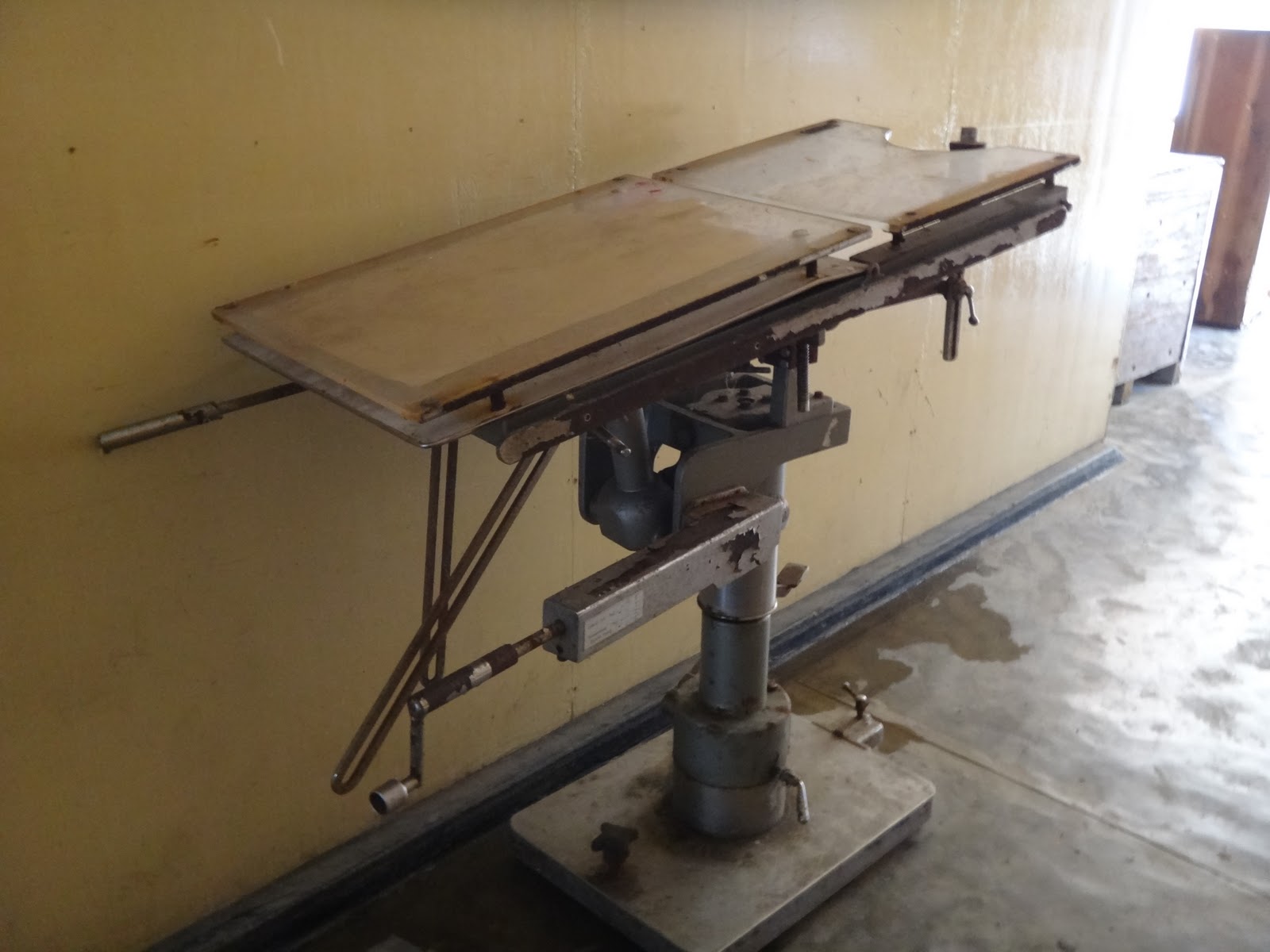
Operating table. No fancy tilt motions here, just up and down. 


In my third week at Karapitiya Hospital I was introduced to Dr. Kumara, senior lecturer in Surgery. Participating in various surgical cases was what I was most looking forward to on my rotation in Sri Lanka. The first thing out of Dr. Kumara’s mouth was, “You’re from the USA? You know Mrs. Obama?” I laughed and said, “No sir, I don’t.” He immediately moved on to his next line of questioning, asking why I chose Sri Lanka of all countries. I proceeded to explain my interest in global health and disaster relief. He cut me off and said, “But there’s no natural disaster right now.” A grin formed across his face and he continued, “Just our whole country’s a disaster!!!” With that introduction we were handed our scrubs and taken to the operating theater.


Changing into some damp scrubs in a small closet.
The white shoes on the floor are the required OT shoes
that we wear instead of booties over our own shoes. 
Walking into the operating theater I noticed it was quite a different set up from the operating rooms back in the states. And it’s  a good thing I had a surgical mask on to cover my mouth because my jaw definitely dropped! Patients were lined up right outside of the open theater doors with their medical chart in hand. Some patients were even curious enough to stand and watch the ongoing procedures from the doorway. On the other side of the patient bench was a make-shift PACU where the post-operative patients were still coming out of their anesthesia. Inside the operating theater, there were multiple procedures going on at the same time. In one corner of the room, a woman was having a lumpectomy under local anesthesia. In the center of the room, a man was under general anesthesia having an open cholecystectomy. Finally, off to the side of the room a woman was getting a carpal tunnel release.


You can see two of the operations going on in the room.
Far patient is lumpectomy, close patient is getting started
with  general for an open cholecystectomy.


As I was taking in the similarities and differences of the operating rooms, one of the general surgeons asked me to scrub for a thyroidectomy. As I got ready to scrub, I noticed there were size 6 or 8 gloves. I’m a 6 ½ so my choices were too tight or too loose. Thankfully my hands managed with a size 6. Anyways, the case got underway and I was impressed by the speed and precision of the surgeon. Thyroidectomies are a very common procedure here in Sri Lanka and these surgeons perform so many each day, I'm sure they could do this procedure in their sleep. A short time later, we were done and ready for the next patient. The turnover time between cases is quite rapid. Turning over an OR at home takes a bit of time, but here, there is no time to waste. They have so many patients in need of surgery and not enough resources to do so. 

One thing I found truly amazing about the Sri Lankans is their strength to overcome adversity. But more impressive is the way they do so without complaint. The patients waiting in the hallway of the theater could be there all day long, sometimes not having their surgery until 1 in the morning, but there was no complaining. I commented to one of the orthopaedic surgeons about how refreshing it was to have people be thankful for the help they are receiving instead of complaining about the wait time, or cosmesis, or post-op pain, or even the food at the hospital! The surgeon told me that Sri Lankas are very accepting of their own problems and illnesses. Then he smiled, leaned in and said, "Sri Lankans don't sue their physicians and that's something you all have to worry about over there." Sri Lankans understand that this is the life they were given and they will deal with it as best as they can. No ambulance chasing or frivolous lawsuits here! Must be nice...

Assisting on a thyroidectomy.
Notice how I'm the only one wearing a mask over both my nose and mouth?


After a few ortho surgeries, I stepped into the general surgery suite to watch an open cholecystectomy. Since we do these procedures laparoscopically, it was a new operation to me. There is only one scope for the entire hospital so most all procedures that we would do laparoscopically at home are performed as an open procedure here.

Similarly, the hospital does not have mesh implants for hernia repairs. Instead, I learned an old suturing technique to weave a meshwork of suture over the opening. Quite impressive and cost effective. As a global practitioner, I’ll need to be prepared to assist in surgeries with fewer resources and embrace both old and new techniques to achieve good end results. I am very grateful to have watched so many procedures and techniques that I won’t get to see (or rarely see) in my training in the US. 

I also spent time with Dr. Kumara during his thyroid, vascular, and endoscopic clinics. In the thyroid and vascular clinics I was surprised to see patients bring their own injections to Dr. Kumara. I have been in peripheral vascular clinics and seen the sclerosing process, but I had never seen a steroid injection delivered right into a goiter. Once again, these Sri Lankans showed impressive strength and not one of them flinched or grimaced at the needle in their throat. I’m pretty sure I would have cried. In the endoscopy clinic, I was was stunned to see that patients were not sedated for upper endoscopies or colonoscopies! But once again, there are no resources available to take care of these patients post-procedure if they were to have an anesthetic. So using a local anesthetic gel on the probe is the only feasible option. Again, not sure I would have been so brave.

I'm not sure I want to share this next story, but since I'm putting it all out there, I may as well. In the middle of the thyroid clinic, Dr. Kumara looked up at me and shouted, "You're going to live to be a hundred!!!" He was so excited I had to laugh and ask why he knew that. Without hesitation he told me it's because I have 5 wrinkles. Great. Awesome. Fantastic. I'm an old hag. I told him that I was trying to get rid of those!!! He shouted "NO! Keep them! You must keep them!" He was serious. And I'm not sure I have a choice in the matter, so I guess I'm keeping my 5 wrinkles, which apparently count for 20 years a piece and I'm destined to live to 100. Longevity does run in my family. I guess I can't take offense to this comment because just moments before he had guessed that I was 23 or 24 years old. Close Dr. K, close. After note to this story- I bought a Sandalwood Oil thingy from an Ayeurvedic herb garden that we went to that next weekend. Apparently mixing sandalwood oil with Vitamin E or aloe and putting it on your face 2x week will get rid of wrinkles (or cellulite or scars, etc). Yep, it scarred me.
This was the wrinkle day.  Can you see the 5 in this close up?

Back to western medicine. When we completed clinic, Dr. Kumara looked at my colleagues and I and said, “WWII is over, you can go talk to the Germans now!” Funny man. Loved him. We got along splendidly. So with that proclamation, we headed to another operating theater where they were having casualty day and met up with two German medical students, also doing an elective rotation. We spent the rest of our day in the casualty theater assisting in I&D’s, suturing small lacerations and bandaging head wounds. Overall, surgery in Sri Lanka very much surprised me. For the limited resources available, the shortage of qualified surgeons and the ever increasing number of patients in need of surgery, the surgeons here are very efficient with their time, skilled in technique and resourceful. We may have different ways of carrying out a procedure, but we all get the job done.

Open cholecystectomy
Looking into the "sterile core" on the left. Sutures, gloves (size 6 or 8 only), other random things you may need during surgery straight ahead.